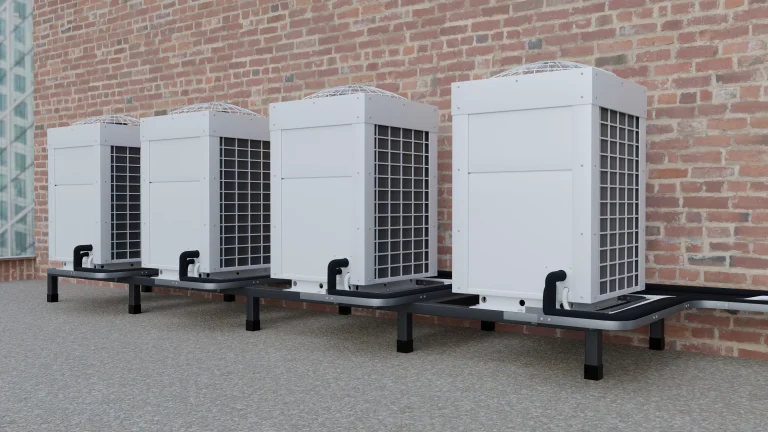
What Are VRF Systems and How Do They Work
A Variable Refrigerant Flow system is a sophisticated HVAC technology that uses refrigerant as the primary cooling and heating medium instead of relying on water or air distribution through extensive ductwork. The system connects a single outdoor condensing unit to multiple indoor units throughout a building, with each indoor unit capable of being independently controlled. The term “variable refrigerant flow” refers to the system’s ability to precisely regulate the amount of refrigerant delivered to each indoor evaporator, adjusting output in real time based on the exact demand of each zone.
VRF systems come in two primary configurations. Heat pump VRF systems can provide either heating or cooling to all zones simultaneously but cannot do both at the same time. Heat recovery VRF systems, on the other hand, can simultaneously heat one zone while cooling another, redistributing thermal energy within the building for remarkable efficiency gains. Industry data suggests that VRF systems can achieve energy savings of 30 to 50 percent compared to conventional HVAC systems, making them an increasingly popular choice for building owners looking to reduce operational costs and carbon footprints.
Key Advantages of Choosing VRF Technology
The benefits of VRF systems extend well beyond energy savings. These systems are engineered to provide precise comfort in ways that traditional forced-air systems simply cannot match. Because each indoor unit operates independently, occupants in different rooms or zones can set their preferred temperatures without affecting the rest of the building. This level of individual control is particularly valuable in mixed-use buildings, office environments, hotels, and multi-family residential properties.
Additional advantages that make VRF systems stand out include:
- Quiet operation due to inverter-driven compressors that modulate speed rather than cycling on and off abruptly
- Compact footprint requiring significantly less mechanical room space than traditional chiller or boiler systems
- Design flexibility with a wide range of indoor unit styles including ceiling cassettes, wall-mounted units, ducted units, and floor-standing models
- Reduced installation complexity since small-diameter refrigerant piping replaces bulky ductwork in many applications
- Scalability allowing systems to grow alongside building expansions without requiring a complete redesign
Applications We Serve Across Residential Projects
Our team at Liberty Mechanical has installed and maintained VRF systems across a diverse range of building types throughout Lakeway, The Hills, Bee Cave, Hudson Bend, Briarcliff, & Lost Creek, TX. VRF systems are becoming increasingly popular in custom homes and luxury properties where homeowners want whisper-quiet comfort without visible ductwork or bulky equipment. Historic homes and older buildings that lack the space for traditional duct runs are also excellent candidates for VRF retrofits, since the slim refrigerant lines can be routed through walls and ceilings with minimal disruption to the existing structure.
Our Installation and Maintenance Process
Proper VRF system design and installation require specialized training and meticulous attention to detail. Our process begins with a comprehensive load calculation and site assessment to determine the exact heating and cooling requirements for every zone in the building. We evaluate factors such as building orientation, window placement, insulation levels, occupancy patterns, and internal heat gains from equipment and lighting.
Once the system is designed and installed, ongoing maintenance is critical to preserving performance and longevity. Our maintenance approach follows a structured methodology:
- Regular refrigerant charge verification to ensure the system operates at peak efficiency without leaks or imbalances
- Filter cleaning and replacement on all indoor units to maintain healthy air quality and proper airflow
- Comprehensive diagnostic testing of controls, sensors, and inverter boards to catch potential issues before they become costly failures
VRF technology continues to evolve rapidly, with manufacturers introducing higher-efficiency models, improved refrigerants with lower global warming potential, and smarter controls that integrate with building automation systems. At Liberty Mechanical, we stay at the forefront of these developments to ensure our customers always receive the most advanced, reliable, and efficient climate control solutions available. Contact us today to discuss how a VRF system can transform comfort in your building.